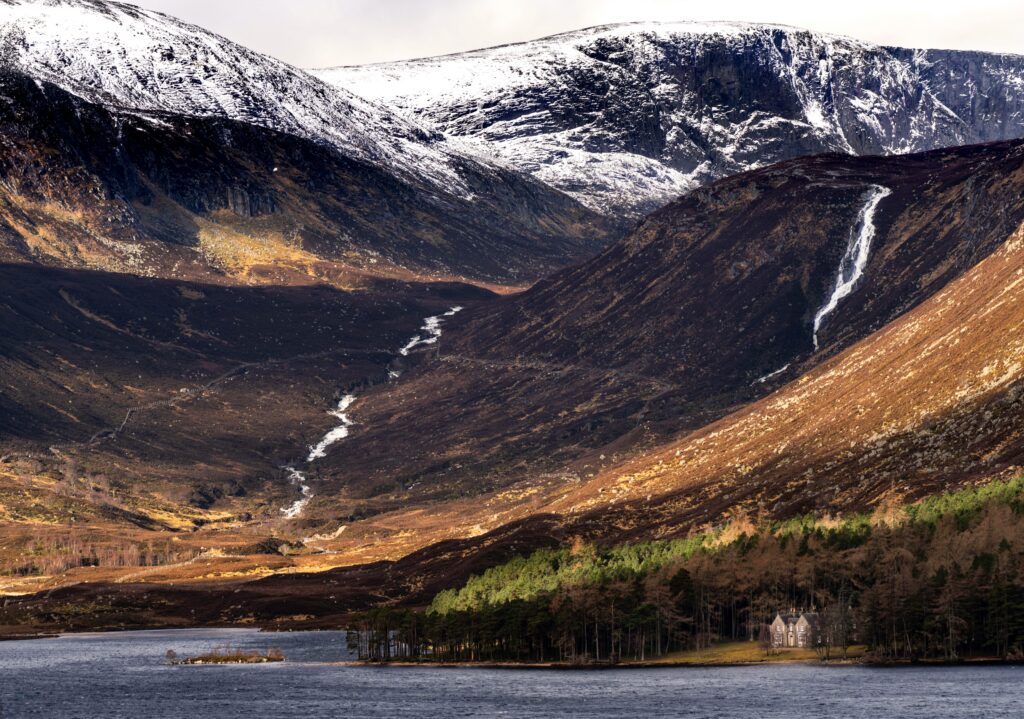


A University of Cambridge-led team has used aerial laser scanning and an AI-supported analysis method to map more than six million individual trees across part of the Cairngorms National Park, showing native woodland spreading naturally following an increase in deer culling.
The study, published in the Journal of Applied Ecology, covered a 569 sq km survey area within the Cairngorms Connect nature restoration partnership, the largest contiguous partnership of its kind in the UK. It was formed a decade ago by RSPB Scotland, Forestry and Land Scotland, NatureScot and WildLand Ltd, and aims to double the size of the existing forest, largely through natural regeneration.
The data was collected by LiDAR from a light aircraft flying 600m above the ground. The system fires laser pulses towards the ground and records the time each takes to bounce back, building a three-dimensional image of the landscape. The team’s method identified each tree and recorded its exact height.
The results show that 2.65 million trees, just over 40% of those surveyed, were under five metres tall. These regenerating trees grow mostly near the edges of existing forests, but some were found more than half a kilometre from the forest edge. Fewer new trees had established in boggy areas than in dry heathland.
The study found that more than 5,235 hectares of previously open land within the partnership now supports young woodland, defined as land with more than 100 trees per hectare. Most of it has established naturally.
Point measurements on the ground validated the results, and comparison with field surveys by Cairngorms Connect and RSPB Scotland showed the method could accurately assess forest expansion at a landscape scale. Airborne LiDAR had previously been piloted only for mapping young trees.
Dr Aland Chan of the University of Cambridge’s Centre for Landscape Regeneration, who co-led the work, said: “The ability to map regenerating trees so precisely, at such a huge scale, is a breakthrough for monitoring nature restoration at a landscape scale. It means we can effectively map young trees, assess whether restoration targets are being met, and inform future restoration work.”
Dr Pip Gullett of the Cairngorms Connect partnership, a co-author of the study, said: “The new LiDAR-based method is excellent at tracking where new woodlands are establishing across the landscape, and also for tracking the impacts of fires – which are increasing in severity with climate change.”
She added: “This is going to be a great way to monitor large-scale woodland expansion going forward, as more and more landowners across Scotland are looking to re-establish native woodlands.”
The team says the approach could complement, or partly replace, hundreds of hours of ground surveys by staff and volunteers. The Scottish Government is funding a nationwide LiDAR survey, and the team hopes its method will be used to monitor nature recovery in Scotland and across the UK.
The research was carried out by Cambridge’s Centre for Landscape Regeneration, with funding from the Natural Environment Research Council and the Endangered Landscapes and Seascapes Programme, in collaboration with Cairngorms Connect and RSPB Scotland. Tarides SAS also supported the work.
The data also feeds into Tessera, a University of Cambridge AI foundation model trained on patterns in European Space Agency satellite data, which is designed to let non-experts use satellite data to map changes in forests over time.