


Scottish space technology company Aurora Avionics has integrated its PF1 on-board computer system into a German research rocket ahead of the system’s first test flight in October.
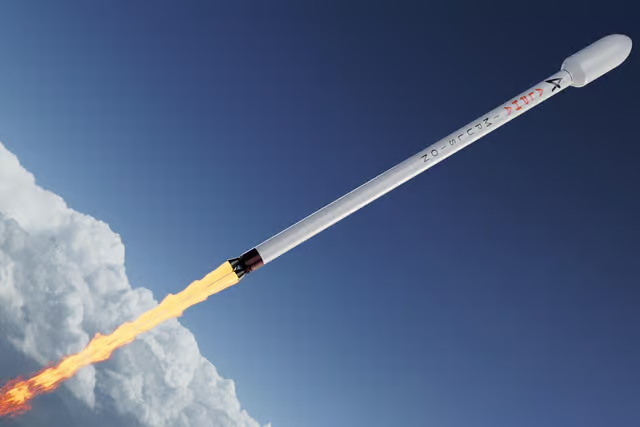
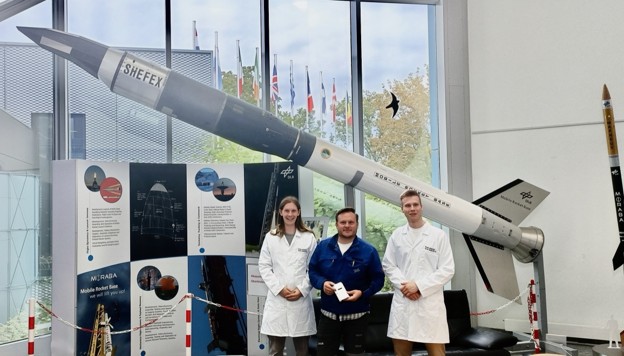
Engineers from the company travelled to the German Aerospace Centre (DLR) site near Munich to integrate the system with the MAPHEUS sounding rocket, which serves as a platform for materials physics and life science experiments under microgravity.
DLR, the national research and technology organisation for aeronautics and space research in Germany, launches a MAPHEUS rocket every year. The rocket reaches altitudes of up to 300 kilometres, creating the conditions needed for a range of scientific experiments on board.
Aurora Avionics worked with DLR’s Mobile Rocket Base (MORABA) team to install and test the hardware for its first experimental prototype system within a day. The hardware includes a camera, a service module and supporting equipment.
The system will form part of the payload on the MAPHEUS-17 mission, which is due to launch from Esrange, Sweden, in October.
Myles Bax, commercial lead at Aurora Avionics, said: “Seeing our technology being integrated into a major German research system is an exciting moment, not only for our firm but for the wider Scottish space industry.
“Hardware developed here in Scotland is now being integrated into major European programmes, highlighting the growing role the country is playing within the international space sector.”
Dorian Hargarten, head of DLR’s MORABA, said: “The close collaboration between our engineering teams allowed the integration and testing process to be completed very efficiently.”
Oren Smith-Carpenter, chief executive of Aurora Avionics, said: “Seeing our system successfully integrated into a complex research rocket marks a major moment. The speed at which we were able to complete the integration is testament to our deep understanding of DLR’s system and the close collaboration between both engineering teams.
“Flying on a major European research mission gives us the opportunity to test how our technology performs within a real launch environment and demonstrate our capabilities on an international stage.”
The mission adds to the company’s work in Europe. Last year, Aurora Avionics signed a £525,000 deal with Spain-based Pangea Propulsion, and it has recently agreed a partnership with France-based Alpha Impulsion.
The company provides avionics systems for future space launch campaigns. Its engineers will continue to provide technical support as the system is prepared for the mission.