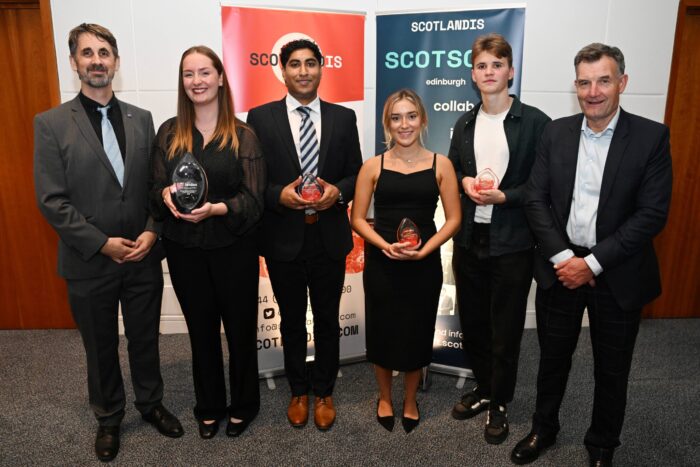
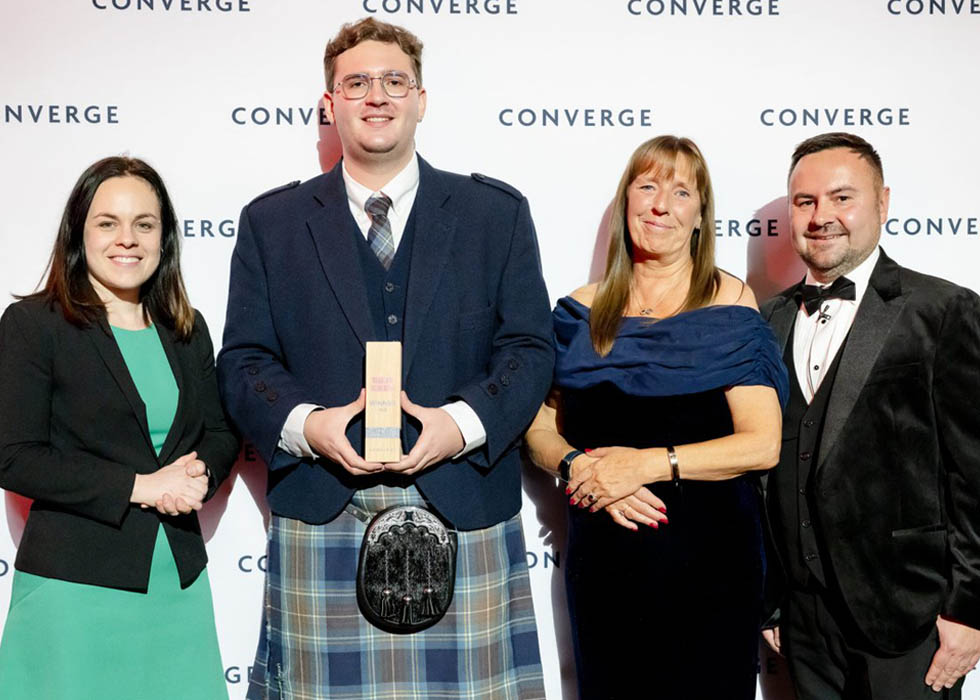


A University of the Highlands and Islands computer science student has secured £15,000 in funding after his pioneering artificial intelligence application for sign language translation captured two prestigious awards at Scotland’s leading entrepreneurship programme.
Christopher Kaan Caudwell, studying at UHI Perth, claimed both the KickStart Challenge (£10,000) and the Data Lab Early-Stage Award (£5,000) at the 2025 Converge Awards for his AI-powered application called Gestura. The awards ceremony, held on 2 October 2025, recognised Scotland’s most innovative university-led business ideas across multiple categories.
Gestura represents a significant technological advancement in accessibility technology, using smartphone cameras to provide real-time, bidirectional translation between British Sign Language and spoken English. The application is designed for practical deployment in everyday settings including hospitals, banks, and public transport systems where professional interpreters may not be readily available.
Growing Market Opportunity
The recognition comes as the global sign language apps market experiences substantial growth, valued at $1.41 billion in 2024 and projected to reach $3.10 billion by 2032, representing a compound annual growth rate of 9.67%. Industry analysts attribute this expansion to increasing smartphone adoption, advancing artificial intelligence capabilities, and growing awareness of accessibility requirements across public and private sectors.
The UK market presents particularly strong opportunities, with recent census data revealing that 117,300 people in Scotland can use British Sign Language. When extrapolated across the UK’s population, this suggests approximately 1.5 million people have some BSL capabilities. However, current estimates indicate that only around 151,000 people across the UK use BSL, with 87,000 being deaf.
Technological Innovation in Accessibility
Gestura’s development reflects broader technological trends in accessibility innovation. The application leverages cloud-based AI processing to analyse hand gestures, facial expressions, and body language captured through standard smartphone cameras. This approach addresses key limitations identified in previous sign language recognition systems, including the requirement for specialised hardware or controlled environments.
The technology builds on recent advances in computer vision and machine learning that have improved real-time gesture recognition accuracy. However, industry experts note significant challenges remain in developing robust sign language translation systems, including limited training datasets, variations in signing styles between individuals and regions, and the complexity of translating contextual meaning.
“I am absolutely delighted to have won the Converge KickStart Challenge Award and The Data Lab Award. This recognition is a huge boost and reflects the hard work and vision that have gone into developing Gestura. It strengthens my belief in the positive impact this innovation will have, and I am excited to keep pushing it forward,” Caudwell stated following his awards success.
Competitive Landscape
Gestura enters a competitive but fragmented market where existing solutions face significant technical limitations. Current commercial offerings include apps like Sign Language AI, which recognises over 2,600 American Sign Language signs, and Signapse, which provides video translation services for British Sign Language. However, many existing applications struggle with real-time accuracy and comprehensive vocabulary coverage.
Recent industry developments demonstrate growing investment in the sector. In January 2025, the University of Surrey received £8.45 million from the UK Engineering & Physical Sciences Research Council for SignGPT, a five-year project developing large language models for sign language translation. Similarly, companies like Robotica have developed broadcast-standard AI signing avatars for television programming.
Commercial Prospects
Gestura’s dual award recognition provides important validation and financial resources for continued development. The Data Lab Early-Stage Award specifically supports data-driven innovations, reflecting the application’s reliance on machine learning algorithms and extensive training datasets.
The commercial potential extends beyond individual consumer applications to institutional adoption across healthcare, education, and public services sectors. Government initiatives promoting accessibility compliance create additional market drivers, particularly as organisations seek technology solutions to meet legal requirements for inclusive communication.